Introduction
Seeing a healthy balance in the business checking account is always a good thing. But after enough cash accumulates, a new question tends to come up: Should all this money really be sitting here? For many small businesses, the answer may be no.
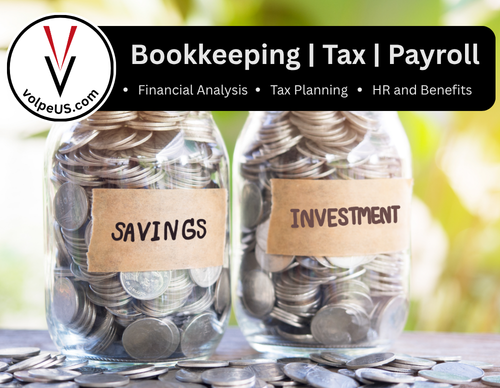
Cash that is not needed for upcoming payroll, taxes, debt payments, purchases, or emergencies may have the potential to earn additional income. That could mean moving some money into an interest-bearing account, purchasing short-term investments, opening a business brokerage account, or directing more money toward retirement accounts. However, investing business funds should not begin with choosing an investment. It should begin with understanding the cash.
Not Every Dollar in the Bank Is Actually Available
One of the easiest mistakes for a profitable business to make is looking at the bank balance and assuming it represents excess cash.
Imagine a company that has $150,000 in checking. At first glance, investing $50,000 might seem perfectly reasonable. However, that $150,000 may also need to cover next month’s payroll, quarterly estimated taxes, sales or payroll tax liabilities, accounts payable, equipment purchases, insurance renewals, and a cash reserve for slower months. The balance may be $150,000, but the amount truly available for long-term investment could be substantially less.
Before deciding what to invest, it can help to divide business cash into categories:
- Operating cash for normal expenses such as payroll, rent, vendors, and recurring bills.
- Tax cash for income taxes, payroll taxes, sales taxes, and other liabilities.
- Reserve cash for emergencies and unexpected expenses.
- Planned-use cash for equipment, expansion, hiring, renovations, or other upcoming needs.
- Surplus cash that is unlikely to be needed in the foreseeable future.
The last category is where an investment conversation can become much more reasonable.
Start With the Time Horizon, Not the Rate of Return
Business owners naturally want their money to earn as much as possible. The problem is that the investment offering the highest potential return may not be appropriate for money the company could need six months from now.
A better question is:
When could the business reasonably need this money again?
Cash needed in the near future generally deserves a different strategy than money the business expects to leave untouched for several years. For example, funds earmarked for next year’s equipment purchase probably should not be heavily exposed to the stock market. Even a strong long-term investment can decline significantly over a short period, and the business may be forced to sell at exactly the wrong time.
Shorter-term business funds may instead be candidates for high-yield deposit accounts, certificates of deposit, Treasury securities, or certain money market investments. This distinction matters because liquidity has value. A business should not have to borrow money at a high interest rate simply because its own cash is tied up in an investment.
Business Brokerage Accounts
A business brokerage account works much like an individual brokerage account, except the account is owned by the business. Depending on the financial institution and account, a business may be able to hold investments such as stocks, bonds, mutual funds, exchange-traded funds, Treasury securities, and money market funds.
For businesses with substantial cash beyond their operational needs, a brokerage account can provide more investment choices than a traditional business checking or savings account. That flexibility, however, also creates risk.
Money invested in securities can fluctuate in value. If a company invests $100,000 that it unexpectedly needs during a market downturn, the question is no longer simply how well the investment performs over ten years; the business may have to sell now. This is one reason we generally view investing business cash as a cash management decision first and an investment decision second.

Do Not Confuse Money Market Funds With Money Market Bank Accounts
The names sound almost identical, but their distinction is important.
A money market deposit account is a bank account and may qualify for FDIC insurance when held at an insured institution. A money market mutual fund, on the other hand, is an investment product. Money market funds typically invest in short-term debt securities and are generally considered relatively low risk compared with many other investments, but they are not FDIC insured.
Brokerage accounts can create another wrinkle because unused cash may automatically be placed into a “sweep” program. Depending on the brokerage, that money might be swept into an FDIC-insured bank deposit program, a money market fund, or another cash arrangement. Those choices can have different interest rates and different protections.
In other words, seeing the word “cash” on a brokerage statement does not necessarily tell you where the money is actually being held.
Do Not Forget Retirement Accounts
When business owners think about investing excess cash, they sometimes focus entirely on taxable investment accounts while overlooking retirement plans. Depending on the business, options could include a SEP IRA, SIMPLE IRA, solo 401(k), traditional 401(k), or another qualified retirement plan. These accounts serve a different purpose than a business brokerage account. They are intended for retirement savings and come with contribution, eligibility, tax, and withdrawal rules.
For example, SEP plans allow employers to make retirement contributions for themselves and eligible employees which can be used by businesses of any size, including self-employed individuals. For 2026, SEP contributions generally cannot exceed the lesser of 25% of an employee’s compensation or $72,000.
The regular employee elective deferral limit for many 401(k) plans is $24,500 for 2026, before applicable catch-up contributions. That does not mean one plan is automatically better than another. The appropriate structure may depend on the number of employees, payroll, owner compensation, desired contributions, administrative costs, and the employer’s willingness to make contributions for employees. Retirement planning therefore becomes part of business planning, tax planning, and compensation planning rather than a separate conversation.
Taxes Still Matter When the Business Invests
An investment earning money does not necessarily mean the business keeps all of that return.
Interest, dividends, realized capital gains, and other investment income can create tax consequences. How those items ultimately affect the owners depends in part on the type of entity, the investments involved, and the business’s overall tax situation.
Accounting can also become more complicated. Investment accounts may contain purchases, sales, reinvested dividends, interest, realized gains and losses, fees, transfers, and year-end tax reporting. Those transactions need to be properly recorded and reconciled rather than treating every transfer between the checking account and brokerage account as an expense or income. This is an area where bookkeeping and tax planning should be working together.

One Account Does Not Have to Serve Every Purpose
A small business does not necessarily have to choose between keeping everything in checking or investing everything for the long term. A layered approach often makes more sense.
The business might maintain sufficient checking for immediate operating needs, keep additional reserves somewhere liquid and interest-bearing, use short-term investments for money that will not be needed immediately, and invest truly long-term surplus funds differently. At the same time, the owners may be contributing through an appropriate retirement plan.
The goal is not to squeeze the maximum possible return out of every available dollar. The goal is to make sure each dollar is positioned appropriately for what the business may eventually need it to do.
The Conversation Should Start With the Financial Statements
Before opening another account, look at the bigger picture.
Is the company consistently generating positive cash flow? Are there large tax liabilities approaching? Is accounts receivable increasing? Does the business have expensive debt that might be better paid down? Are major purchases expected? Is revenue seasonal? How much cash would the company need if sales suddenly slowed? Those questions can completely change what “excess cash” means.
A company with $200,000 in the bank and $150,000 in upcoming obligations is in a very different position from a company with the same bank balance and minimal short-term liabilities. That is why investment decisions should not be made by looking at a bank balance in isolation. For a small business, having money available to invest is a positive problem to have where the next step is making sure the decision strengthens the business rather than quietly creating another risk.
Before moving significant business funds into investments, reviewing cash flow, upcoming obligations, tax considerations, and long-term plans with your accounting and financial professionals can help determine not only where the money could earn more, but how much of it the business can truly afford to put to work.
Contact Volpe Consulting & Accounting to learn how we can help you manage payroll expenses, improve cash flow planning, and make more informed financial decisions for your business.
If there’s a pain point within your operation that you’d like to discuss, we’re here. We’d appreciate the opportunity to look into it with you and hopefully provide some insight as to how you can move forward. For more information, or to just put a few faces to the name,
Disclaimer
This article is intended for general informational purposes only and does not constitute legal, tax, payroll, or accounting advice. Payroll rules and tax rates may change, and the correct treatment depends on each business and employee’s circumstances. Employers should consult qualified professionals regarding their individual situation.